*********************************************************************************SEPTEMBER2026************************************************************************************
*03-09-2026
Letter on Irish Defence Attachés.
Irish Examiner.
‘Dear Sir,
I was confused and saddened to hear that Ireland is to send ‘Defence Attachés’ to our embassies in France, UK and USA. This is further erosion of our neutrality, and further disregard for the will of the Irish people. It is out-of-step with Article 29 of our Constitution and will incur additional unwarranted expense, at a time when so many of our people are experiencing hardship.
According to a press release on gov.ie on the 4th of August, the role of these Attachés will be to ‘build relationships with partner armed forces’. The press release also states that the appointment of the three Defence Attachés will support something called ‘defence diplomacy’ and will help ‘deepen defence co-operation with three of Ireland’s closest strategic partners’. As a neutral, nonaligned country, do we have ‘partner armed forces’ and ‘strategic partners’?
As Éamon Ó Cuív said, at an event in Dublin on the 7th of March, ‘the first basis of security for a country, just as with personal security, is not to threaten any other country, and not to be seen as aligned militarily with countries whose overseas interests appear to pose a threat’.
We must distinguish between ‘defence’ and ‘security’. Defence is a typical response when we ‘feel’ threatened – whether the threat is real or not. It has no place in secure relationships. If we are defensive in our relationships with others (whether personal or international), we lose trust and become suspicious, we shut down communication, we blind ourselves to the good in the other, and we interpret everything in a way to reinforce our sense (and our narrative) of threat. This is a sad rejection of ‘the ideal of peace and friendly co-operation amongst nations’ (Article 29, Bunreacht na hÉireann).
Defence suggests tension, distrust, suspicion and a built-in need for escalation. If I am to defend myself, I need bigger and more powerful weapons than yours. Security, on the other hand, suggests calm, trust, openness and relaxation (disarmament). Establishment of a common security, especially with those we fear, is the best type of security, and reduces the need for ‘defence’. Within a common security, we use diplomacy to settle disputes, and work together on the basis of mutual agreement not to threaten or harm each other.
Instead of ‘Defence Attachés’, why not send ‘Peace Attachés’, and send them to countries that we feel might pose a threat to us? This would be much more in keeping with our foreign policy, set out so clearly in Article 29 (which includes Ireland’s adherence to ‘the pacific (peaceful) resolution of international conflicts’). This would be international diplomacy as it is meant to be.
Yours,
Marian Naughton.’
Marion Naughton is a Psychologist for Peace and member of Lex Innocentium 21st Century
***************************************************************************AUGUST 2026**********************************************************************
*29-08-2026
‘The Irish Government is helping to usher in a new wartime economy in Europe’
‘Europe has stumbled into a new growth paradigm with a reliance on the permanent threat of war’
The Irish Times. Sinéad O’Sullivan. Sat Aug 29 2026
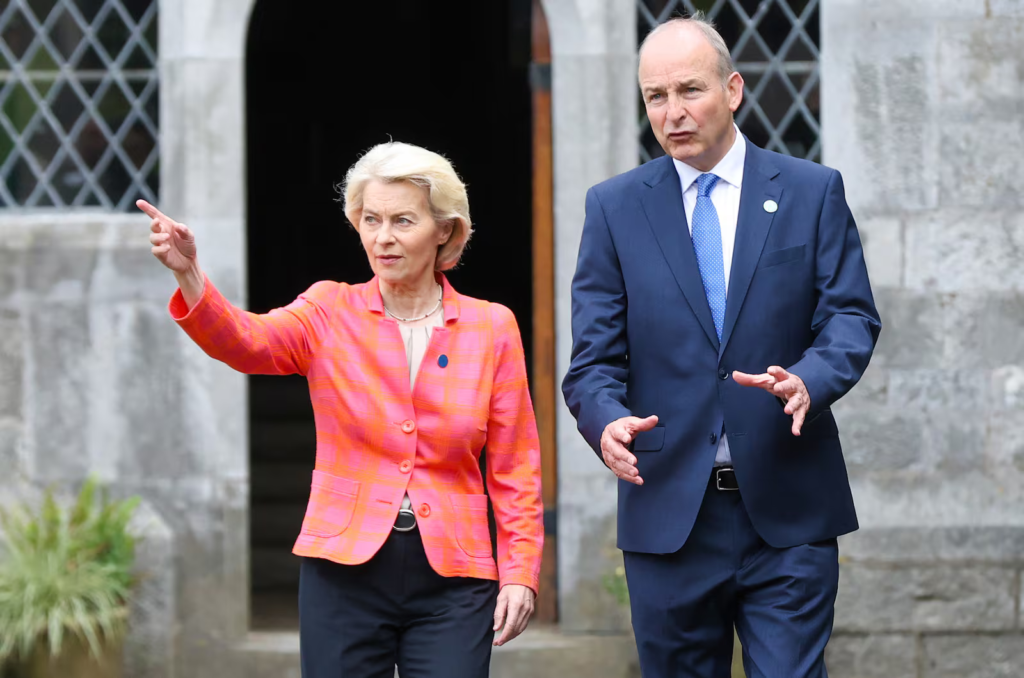
‘European Commission president Ursula von der Leyen and Taoiseach Micheál Martin at University College Cork as Ireland’s presidency of the Council of the European Union began.’
Photograph: Paul Faith/PA Wire
‘At the launch of the White Paper for European Defence – Readiness 2030, Ursula von der Leyen declared the era of Europe’s peace dividend “long gone”. Peace, apparently, was a phase that we have now outgrown.
The EU’s centre of gravity has rapidly moved from a focus on trading to armament, as outlined by von der Leyen in early 2025, and this transfer of meaning is not happening through defence memorandums but through nation state treasuries. Consider the following: the European Commission is in the midst of mobilising €800 billion defence spending by 2030; more than 15 member states have activated “escape clauses” to enable an economic breach of fiscal rules to procure weapons; €150 billion of so-called “bomb bonds” has been raised for collective borrowing; a new multilateral bank – the Defence, Security and Resilience Bank – is targeting hundreds of billions of euro, with Belgium, Greece, Romania, Latvia and Ukraine among its founders; Canada has been admitted as a non-EU member state, in a leadership role, on many of these initiatives.
What if Europe is no longer a trading bloc that hopes to enable peace, but a geographic union whose budgets and institutions are being rebuilt around the certainty of war?
In February, Canada became the first non-EU member state admitted to Europe’s joint weapons-procurement fund, with Canadian firms being allowed to supply up to 80 per cent of Europe’s arms contracts, more than twice the cap applied to any other outside country. Further, Europe’s new defence bank is Canadian-led, despite being Luxembourg-based. Put another way, a North American G7 heavyweight, and a founding Nato member, now exists within the EU’s defence architecture.
What then, when confronted with these facts, does the European Union resemble more closely – a single-market trading bloc with a foreign policy, or a defence alliance with a currency backed by wartime industrialisation?
This change is all but reversible. Germany’s broken industrial model – of using cheap Russian energy that came with a price that was never accounted for to manufacture cars that are more expensive than their Chinese equivalents – has been catastrophic for local jobs and communities. But in this vacuum, the economic lottery ticket of wartime manufacturing provides an immediate relief, as expensive energy doesn’t matter when the customer is the government itself – buying ammunition.
Thus, Europe has stumbled into a new growth paradigm built on militarisation that comes with a large economic reliance on the permanent threat of war.
Similar to Germany, Emmanuel Macron’s France has doubled its defence budget since 2017 with several austerity measures in place for social spending. The fastest growing large economy in Europe – Poland– now allocates a quarter of its budget to weapons. Joining on this new strategy on Europe’s periphery is the UK – with a new Defence Investment Plan favouring military investments over transport and energy infrastructure, while incentivising British firms to engage more deeply with the defence supply chain.
Meanwhile, the urgency to grant Ukraine immediate accession to Europe has only accelerated Europe’s largest postwar restructuring. Volodymyr Zelenskiy’s request goes far beyond just enlargement; it is viewed as a useful vehicle through which Europe can be reindustrialised for war – to rebuild its defence-industrial base and to make more concrete a new security architecture.
This is happening, in part, in Dublin. Through the assumption of the EU presidency, it is Irish ministers who are contouring Europe’s new form by leading these very negotiations on accession and defence alike. Somewhere between discussions on GDPR and agricultural subsidies, the architecture of this new military pact is being defined.
But do our elected politicians realise that they are convening a new continental war economy, most likely away from our own interests? As Europe’s fiscal and industrial growth becomes tightly coupled with a permanent war-footing and increasingly reliant on government spending through the current war, is there a gross misalignment of incentives – that we should want this war to end, while our economy will need it to continue?
While it is true that post-American European power urgently needs a new security model in addition to a new economic model whether these two become the same is a deeply moral and political question for the member states with skin in the game.
Ireland’s relationship with neutrality has not yet updated to this new reality. We obsess over whether Ireland might one day find itself joining Nato without realising that we may already be inside the new defence alliance that will eventually take Nato’s place.
Amid the most consequential realignment of European power since its formation, what remains of the Republic’s role in a militarised union with no fiscal or industrial leverage against its peers? With an unsubstantiated and ill-defined agreement between the State and its citizens on the topic of neutrality, can Irish people trust that a wink and a nod from the political class will suffice to safeguard our desire for non-alignment? And trust whom, exactly?
Let’s look at the record of the Taoiseach doing the winking. Micheál Martin’s Defence (Amendment) Bill 2026 seeks to remove the triple lock, thus reneging on the UN mandatory requirement his own party gave as a guarantee of Irish neutrality. Of course, when 400 academics and university workers wrote against this volte-face, he later dismissed opponents of the reform as guilty of “wide misrepresentations and demagoguery”, while in the same breath assuring Irish people that “we’re not joining any military bloc”.
Yet Martin committed Irish troops to a German-led EU Battlegroup not contingent on a UN mandate, withdrawing 130 UN peacekeepers to do so; signed an Individually Tailored Partnership Programme (ITPP) with Nato; and sent air defence radar systems to a country at war without the need for the peoples’ mandate.
It is therefore hard to imagine, as he tours Kyiv pledging to use every available accession cluster to clear Ukraine’s path into a militarised EU, that Martin can be trusted as custodian of a neutral state.
What is perhaps more plausible is that we have a leader who sees no clear need for Ireland to enter Nato, because he suspects, like me, that Nato is over – and that the EU has taken its place; a bloc in which Ireland is already in.
Standing behind him now is von der Leyen, Germany’s former defence minister, who has shaped the new European order in the mould of a German crisis – not Ireland’s interests.
Irish neutrality was able to endure through Europe when it acted as a peace project of 1957, but it is unclear that it will still be intact after the 2026 defence project Europe is becoming. The time to define and protect Irish neutrality is now.’
Source: The Irish Times
*23-08-2026
The Eamon O’Cuiv Triple Lock & Irish Neutrality Interview. 
Éamon Ó Cuív, former deputy leader, Minister and TD for the Fianna Fail Party is interviewed by Eddie O’Brien of the Thinking Centre, Clonmel, with a focus on Irish neutrality and the Triple Lock.
You can watch the interview at these 3 links, each approx. 20 mins. in duration.
https://drive.google.com/file/d/1skt6CQlyZkb_NT3xeRf9K-DD1VlLOfBv/view?usp=sharing
https://drive.google.com/file/d/1qbXnKOMF2sk-nNla4LEVrfSNKs-lpVdV/view?usp=sharing
https://drive.google.com/file/d/1u2fhomuEJug0rOoXqVnBdylINMr_nkIm/view?usp=sharing
*19-08-2026
“…the world’s most important work, the work of peace”. President J.F. Kennedy Dáil Eireann 1963.
‘In November 2025, the government asked the Irish people to propose themes for their upcoming Presidency of the European Union. 1.
Lex Innocentium 21st Century put forward the theme of peace, and proposed the establishment of a Peace Institute in Ireland. The Minister for Foreign Affairs and Trade, Helen McEntee, however stated that “Supporting Ukraine will be a central priority during Ireland’s EU Presidency later this year.” 2.
Why can the achievement of peace in our troubled world not be the ‘central priority’ of Ireland’s presidency? If we were to adhere to our constitutional obligation to commit to “the pacific settlement of international disputes by international arbitration or judicial determination”, we would be clearly pursuing the path of peace. We would also be working with the United Nations (UN), with its remit for world peace. Unfortunately, the government is doing the exact opposite. Removing the necessity for a UN mandate for the overseas deployment of Irish troops will do two things:-
* it will tend to undermine the status and authority of the UN in Ireland and abroad (whose Charter Ireland is legally bound to uphold), and significantly,
** it will also enable Irish troops to operate under the aegis of the EU.
The Triple Lock was introduced following the rejection of the first Nice Treaty in 2001. Its purpose was to persuade people who had been concerned about the impact of the Nice Treaty on our neutrality to change their minds and to vote to accept the treaty. That Government commitment to neutrality and the Triple Lock was embodied in what the Bertie Ahern Government of that time called the “National Declaration by Ireland”. That National Declaration by Ireland was in turn responded to formally by the other EU States in what was called the “Seville Declaration” of the other EU States 2002 and both Declarations were formally registered at the UN along with the Nice Treaty when that was ratified. The National Declaration of Ireland gave a special legal basis and authority to the Triple Lock. 3.
Of note, the Irish State has never issued a comparable National Declaration on any other issue.
In 2008, the Lisbon Treaty brought Irish foreign and security policy, among other areas, into the remit of the EU, and this was a matter of grave concern to many Irish people
who had serious reservations about the increasing militarization of the EU, and who again (2) voted not to accept the treaty.1.
To renege on this promise is the most anti-democratic action any Irish government has ever taken. The electorate in both referendums had every right to be concerned as Ireland’s military involvement in EU matters has been steadily increasing. Ireland joined PESCO (Permanent Structured Cooperation) in December 2017 (after only a two-hour debate in the Dáil). The legally binding commitments made under PESCO included a commitment to have our military technical standards interoperable with those of NATO, a commitment to regularly increase our defence spending, and a commitment to make the European defence industry more competitive.
In 2021, our peacekeepers were withdrawn from the Golan Heights, where they had been on a UN peace keeping mission for a decade to ensure that our Irish Defence forces would be able to fulfil their commitment to EU Battlegroups. 4. 5.
Irish soldiers are now giving weapons training to Ukrainian soldiers. 6.
The number of military flights over Ireland has also been underreported. 7.
And of course, over the past 25 years, approximately three million US soldiers have passed through Shannon Airport in support of US wars. 8.
More recently weapons have been illegally transported over Ireland to Israel. 9.
The EU and NATO are tightly connected and, currently, NATO and the EU are cooperating on more than seventy measures. 10.
As Ursula von der Leyen said at a joint EU/NATO press conference, “We are one Union, one Alliance, united in purpose.” 11.
The arms industry is playing a large role in this militarization; in 2015, the European Commission created the oddly named “High-level Group of Personalities” on defence
research, over half of whose members represented the military industry. As could be expected, the conclusion of this group’s deliberations was “reinforcing Europe’s overall
military position”, and two years later, the EU approved, for the first time, the funding of military research and the development of new arms and technologies.12.
This trend continued, and two years later again, the European military industry received further support with the establishment of the Directorate-General for Defence Industry and Space.13.
A lot has happened since 2002, when the Berlin Plus Agreement formalized relations between the EU. 1.
The existence of the Triple Lock was referred to by the statutory Referendum Commission (which sent documents about the treaties to all households before the vote) on the second Nice and Lisbon Treaty referendums. These solemn commitments given in two referendums to persuade people to change their votes and permit those treaties to be ratified, have given the Triple Lock a quasi-constitutional character which it would be unconstitutional – not to mind being a profound political betrayal by the politicians concerned – to try to remove by Oireachtas legislation at this stage. The Government’s attempt to abolish the Triple Lock before the end of the year is doubtless meant to give assurances to the EU about the matter before Ireland assume[d] the EU presidency on 1 July 2026, (3) and [to] NATO, (14) and in 2026, an Irishman, General Seán Clancy, Chair of the European Union Military Committee stated that ”NATO remains the bedrock of European defence”. 15.
Militarization comes at an enormous cost; research and development spending in defence in the EU has almost doubled over the past 5 years, growing from 9 billion euros in 2020 to 17 billion in 2025.16.
The EU and member countries have given 82.9 billion dollars to Ukraine since 2022. 17.
In the words of EU foreign policy chief Josep Borell “Another taboo has fallen …the taboo that the EU was not providing arms in a war, yes we are doing it.” 18.
The current plan under “Rearm Europe” is to spend an unbelievable 800 billion euros on arms.19.
This is not what the Irish people voted for. Two referendums, and opinion poll after opinion poll (most recently February 2026), have clearly shown the wish of the Irish people to be neutral in conflict and to act as peacemakers. It is disturbing therefore, to see that there have been few, if any, moves in the EU to seek a peaceful settlement to any of the current conflicts. Two agencies highlight this:
* The European Peace Facility (EPF), established in 2021, is badly misnamed; it is actually a 12 billion euro fund and is “primarily a financing tool for security and defence assistance rather than a diplomatic peace-mediation instrument...” 20. Financing the militarization of Europe cannot be the function of a peace facility. It has already promised 5 billion euros to Ukraine for “lethal and non-lethal military equipment and military training.” 21. There is no requirement for independent evaluation of the European Peace Facility or even for the facility to produce a report. There is no national or EU parliamentary oversight and it has been described as an “unsecured gun”. 22. Its budgetary arrangement ensures that it can circumvent an obligation not to fund warfare.
** A further EU agency, the European Defence Agency (EDA ), was established three years later, in 2004 . Its aims include “acting as a military interface to EU policies” ,
“development of military cooperation” and of course “strengthening the European defence industry”. 23. A recent review of the work of the EDA revealed serious concerns, including being strongly influenced by the arms industry, lack of transparency in the review process, and an excessive reliance on self-assessment by applicants to the EDA. 24.
Where is the EU agency for mediation and conflict resolution?
Minister Helen McEntee’s desire for military support for Ukraine is not in the interest of world peace. 25.
In his auspicious visit to Ireland in 1963, President J. F. Kennedy urged reform of the United Nations. He said that the UN must be fairly financed and its peace -(4)keeping machinery strengthened; he foresaw a world where justice reigned. His call echoes to us through the intervening years and resounds in the wishes of the majority of Irish people for Ireland to be a peace maker. Our government must heed the will of the Irish people, work to strengthen the UN and to resist Ireland’s participation in the increasing militarization of the EU. The Irish government must keep its solemn promise to the Irish people, and heed their wish for Ireland to be a peacemaker, over and above any perceived commitment to the EU.
Our peaceful future needs our government to listen to the people and to keep the Triple Lock.’
 Article by Elizabeth Cullen. Lex Innocentium 21st Century.
Lex Innocentium 21 st Century is an Irish peace movement with our roots in ancient Irish Law (Lex Innocentium/Cáin Adomnáin, 697 AD). Lex Innocentium 21 st Century is a civil-society law that declares war to be a Crime against Humanity, a Crime against the Earth and a Crime against the Future. We invite people from all over the world to sign our soft-power, bottom-up, civil-society law on our website.
Web: https://lexinnocentium21.ie
Email: contact@lexinnocentium21.ie or lexinnocentium21@gmail.com
Instagram: Lex Innocentium 21c
Facebook: Lex Innocentium, 21 st Century
YouTube: https://youtube.com/@lexinnocentium?si=S3pkD7GcUkbb9NUm
1 The Development of the Priorities and Policy Programme for Ireland’s Presidency of the Council of the
European Union 2026
2 Minister McEntee expresses Ireland’s solidarity with Ukraine in Kyiv
3 This information on the Nice and Lisbon referendums and the Triple Lock is from Anthony Coughlan on file
and www.nationalplatform.org
4 Last Irish troops to return home from decade-long mission in Golan Heights – Limerick Live
5 https://www.thejournal.ie/last-irish-troops-syria-un-peacekeeping-to-return-home-6345441-Apr2024/
6 https://militarnyi.com/en/news/ireland-joins-ukrainian-soldiers-training-program/
7 Irish Times “248 US Military flights over Ireland went reported” April 20 2026
8 https://www.shannonwatch.org/Military
9 https://www.ontheditch.com/us-funded-munitions-on-israeli-national-airline/
10 EU-NATO: 10th progress report reaffirms commitment to advancing cooperation amid instability and
security challenges – Consilium
11 https://ec.europa.eu/commission/presscorner/detail/en/statement_22_1332
12 http://consilium,europa.eu/en/policies/defence-numbers/
13 https://enaat.org/wp-content/uploads/2024/12/PeaceDisarmamentInEurope_ENG.pdf
14 under the radar
15 “General Clancy’s NATO stance” The Phoenix March 13 2026
16 https://www.euronews.com/next/2025/11/19/europes-rd-defence-spending-surges-amid-ukraine-war-which-
eu-country-splurges-the-most
17 https://www.eeas.europa.eu/delegations/united-states-america/eu-assistance-ukraine-us-dollars_en?s=253
18 Eu military missions report-web (3).pdf
19 https://stoprearm.org/
20 Letter from MEP on file
21 Ukraine Assistance Fund: Council allocates €5 billion under the European Peace Facility to support Ukraine
militarily – Consilium
22 https://www.investigate-europe.eu/en/posts/european-peace-facility-controversy.0
23 https://www.military.ie/en/public-information/defence-research-technology-and-innovation-rti-unit/european-
funding/
24 https://enaat.org/wp-content/uploads/2025/02/250224_PR-EN_CentreDelas-ENAATreport_EDFreview.pdf
25 Minister McEntee Attends Meeting of EU Defence Ministers Feb 2026
*01-08-2026
“NATO must become more European to remain transatlantic”
Written by Fionn Wallace. Source: Socialist Voice
Link: https://socialistvoice.ie/2026/08/nato-must-become-more-european-to-remain-transatlantic/
(Reproduced with kind permission of author)
‘Elbridge Colby, the US Under Secretary of War for Policy, took to Twitter in April to celebrate the EU stepping up to the plate, declaring that “NATO must no longer be a paper tiger”. He said: “Germany is now taking the leading role in this. After years of disarmament, Berlin is stepping up. The Department of War is already working closely with European allies, especially Germany, to accelerate this transition to NATO 3.0.” He then went on to quote from Berlin’s new Military Strategy: “Germany is taking on a historically unprecedented amount of responsibility for Europe, and will continue to build on this basis. NATO must become more European to remain transatlantic.”
The Berlin Strategy is a blueprint that builds on Colby’s 2026 US National Defense Strategy – a plan that sees the EU buy historic amounts of US military hardware in order to help the US counter the rise of China. Germany is fully on board and is leading the charge in militarising the EU.
On July 1st, Germany effectively ended voluntary participation in the military reserves and extended eligibility from six years after graduation to 65 years of age. All German men of 18 years are now obliged to complete a form indicating their readiness to serve and undergo a medical examination. While conscription proper has not been introduced yet, they are certainly heading in this direction.
One silver lining, though, is that the uptake is very low. The German military sent nearly 300,000 letters to 18-year-olds and only 530 signed up – that’s just 0.18%. Some 5,862 conscientious objector applications were received in the first half of 2026 – 50% more than in the whole of 2025.
In terms of military spending, the German federal military budget has moved from €35.9 billion in 2015 to €125 billion this year, rising each year to just short of €200 billion in 2030. By the end of the decade, Germany will be spending over 30 percent of its federal budget on war preparation. As the German Finance Minister said in Berlin in early June, “We cannot defend ourselves against Putin with a balanced budget.”
German society is being militarised. The so-called Operations Plan Germany (OPLAN) integrates civilian actors and public structures into the German Armed Forces’ war preparations. They are converting hospital car parks into military field hospitals, conducting surveys at nursing colleges that are basically recruitment drives to get nurses into the armed forces, and emergency rooms across Germany are being visited by the armed forces to assess their suitability for wartime functionality. A framework plan for Berlin hospitals has been leaked which is explicit about prioritising care of military personnel over ordinary Germans whenever the two are competing for attention.[1]
In July last year, in Bavaria, a law was passed that places an obligation on education institutions to cooperate with the German military “in the interest of national security”. Universities’ resources and research capacities must be made available to the German army “in the event of necessary military defence”.
This July, there was news of the Rheinmetall arms company expanding into third-level education; they are proposing, among other things, to fund a permanent professorship in one of the colleges of applied sciences.
The German economy is being reorientated towards military production. The industrial decline that spiralled after the Nord Stream bombing is now being turned into a desperate attempt at an arms boom. The German auto sector, once the powerhouse of the EU economy, saw its profits roughly halved for 2025. Volkswagen has announced plans to cut 50,000 jobs in Germany over the next three years. These companies are turning to the arms sector, where the EU has been working hard to improve capital-market access for all things military.
Volkswagen is in talks with Israeli companies with the aim of starting to produce components for Israel’s Iron Dome system by 2027. Companies are adding extra shifts to churn out weapons and ammunition for Ukraine. American Patriot interceptors are soon to be manufactured in Germany to meet demand.
German districts, like much of the EU in general, are facing multiple budgetary crises, and they are being told to improvise with less. This means diminished public transport services, dilapidated schools, and closed public amenities like swimming pools. This is the reality of NATO 3.0 – war preparation as a massive transfer of public wealth to private war profiteers.
And while this “defence” industry revolution is being spun as a massive buy-European initiative, the reality is that the US is the one that is – and will continue to – profit on EU funds, both public and private. The head of the German air force recently told Politico that the EU had to buy US-made weapons immediately because the urgency of the Putin threat means we cannot wait around for the development of European weapons systems.
Responding to this article, Elbridge Colby said: “The United States, as the President says, makes the best equipment, and we make it at a scale that no plausible competitor can match. If anything, access to the American defence industrial base is a privilege, not a right.”
US elites and the State Department pose an extraordinary threat to the people of Europe. First they precipitated the Ukraine conflict, bringing war to our borders and a cost-of-living crisis due to the backfire of sanctions against Russia. The US organised the bombing of Nord Stream, exacerbating the cost-of-living crisis and conveniently forcing Europe to buy American fracked gas at four times the price. They are meddling in the internal politics of multiple European countries in order to promote far-right and fascist forces. They are scooping up undervalued European companies at an increasing rate, due to a weak euro and a generational handover for which European business-owners are ill-prepared. They are profiting massively from the arms expenditure bonanza they strong-armed us into. They are mining the EU for companies – the likes of Blackstone Real Estate are mining us for rent – while US tech giants are mining us as a data-centre sacrifice zone.
The EU is taking on public debt to pay the US for weapons we do not need, to fight a direct war with Russia that our genocidal elites are sleepwalking us into at the behest of the US and some uniquely deluded European elites who think all this is going to make Europe great again.
Germany is spearheading this direction of travel, but they are responding to and working in concert with Brussels and Washington. When finalised, the proposed EU 2028–34 budget is expected to see a fivefold increase in EU budget funding for investment in the military sector. Dedicated climate, health, and conflict-prevention and peacebuilding spending are all being cut to zero. The common agricultural programme is being cut alongside social spending on poverty reduction, social inclusion, employment support, skills training and education.
The Irish government, for its part, is doing everything in its power to anti-democratically bring the country into the fold of the genocidal and white supremacist NATO/EU military axis.
We need to educate and organise against the EU, its militarisation and drive to war, its rapidly increasing repression of dissent and resistance, and its theft of our public wealth to enrich a shrinking group of capitalist elites who would happily watch the world and all the people in it burn in order to protect their profits.’
[1] Volker Mörbe, ‘Die Militarisierung des Gesundheitswesens’, Informationsstelle Militarisierung IMI, 16 March 2026.
*01-08-2026
‘Eamon de Valera’s iconic speech confronting Churchill, during his radio announcement to the Irish public in 1945. It was a great example of the powerful impact our Irish neutrality asset can have, when used so meaningfully, actively and courageously’. Lex Innocentium.

In his Victory in Europe Day speech, Churchill had been critical of De Valera and Ireland’s neutrality throughout the war. Three days later, De Valera broadcast his response, which was widely praised for its clarity, dignity and restraint.
Link to Eamon de Valera’s speech on YouTube: https://youtu.be/zbgPpG8pO8U?si=nOnt_EUEvpR4yBKb–
******************************************************************************JULY 2026*******************************************************************************
*16-07-2026
A Rational Conversation on Neutrality at Galway Arts Festival?
‘Neutrality: A Rational Conversation’ is the title of a ‘First Thought’ talk at the Galway International Arts Festival on Friday 17th July. It features Austrian academic Professor Martin Senn, Irish Times security correspondent Conor Gallagher, and journalist Lara Marlowe. It is described as “a practical discussion about how to proceed” so one might expect a balanced discussion. Yet the composition of the panel raises an obvious question: where is the balance? Or, is this just another exercise in reinforcing a predetermined narrative dressed up as intellectual inquiry?
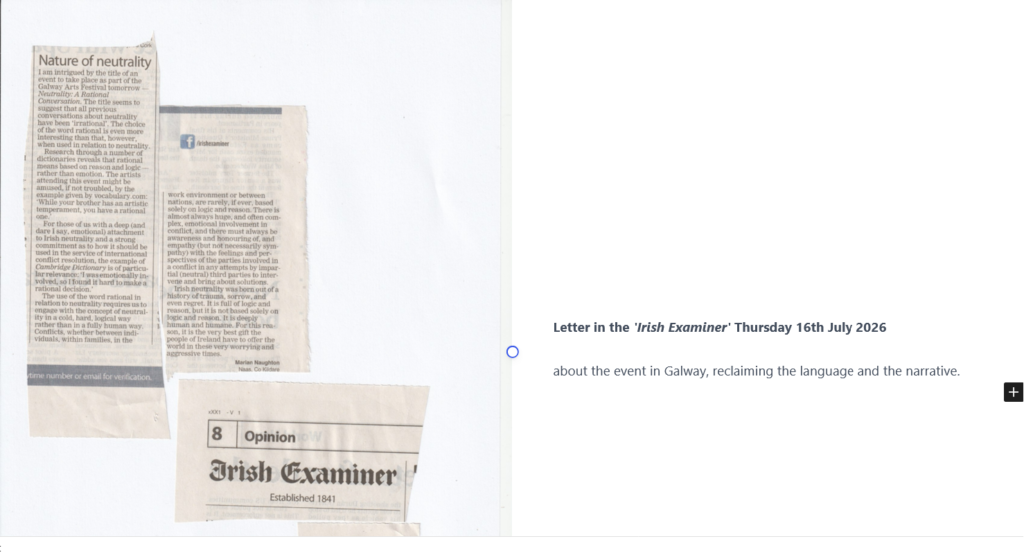
Letter printed in the ‘Galway Advertiser’.
Dear Editor,
The issue of Irish neutrality is currently under review, or under attack depending on one’s perspective. The government seeks to remove the Triple Lock —the final democratic safeguard against Irish Defence Forces being dragged into foreign wars.
‘Neutrality: A Rational Conversation’ is the title of a ‘First Thought’ talk at the Galway International Arts Festival featuring Austrian academic Professor Martin Senn, Irish Times security correspondent Conor Gallagher, and journalist Lara Marlowe. It is described as “a practical discussion about how to proceed” so one might expect a balanced discussion. Yet the composition of the panel raises an obvious question: where is the balance?
Martin Senn and Conor Gallagher discussed this subject together at the European Parliament offices in Dublin in March this year. Senn argued that neutrality is a flexible concept that must evolve to meet contemporary security needs. He described Austrian neutrality as a barrier to a “reasonable” defence policy—a message clearly intended for Irish audiences. Gallagher’s book, ‘Is Ireland Neutral? The Many Myths of Irish Neutrality’ and his commentary on the subject consistently dismiss Irish neutrality, leaving us in little doubt about his own conclusions. Marlowe, a respected war correspondent, sometimes relies on pro-military sources without a critical balance.
A talk comprised entirely of speakers broadly sympathetic to the government’s position cannot be described as a balanced or rational conversation. Rather, it is reminiscent of Micheál Martin’s Consultative Forum on International Security Policy which proved to be an exercise to reinforce the government’s already established policy direction.
Public opinion polling has consistently shown strong majority support for retaining Irish neutrality and current policies including the Triple Lock. Where is that voice on this panel?
Organisers could bring balance by adding speakers with expertise capable of presenting the alternative view. Obvious choices include former Irish Army officer Senator Tom Clonan, a widely published commentator on defence and neutrality, or Dr Karen Devinewho is one of Ireland’s foremost academic experts on neutrality. There is also Niamh Ní Bhriain, a leading researcher on international peace issues who has spearheaded the Neutrality Roadshow across Ireland over the past year.
Without such voices, the event risks becoming another exercise in reinforcing a predetermined narrative dressed up as intellectual inquiry.
Galway Alliance Against War. published 25/6/2026
*14-07-2026
Irish troops form part of the ‘Coalition of the Willing’ marching down the Champs-Élysées in the French military parade for Bastille Day 2026.
The Irish tri-colour is on display as part of what France calls ‘a symbol of Europe’s strategic awakening’ (according to https://english.aawsat.com/world/5295799-france-showcases-500-pro-ukraine-troops-bastille-day)
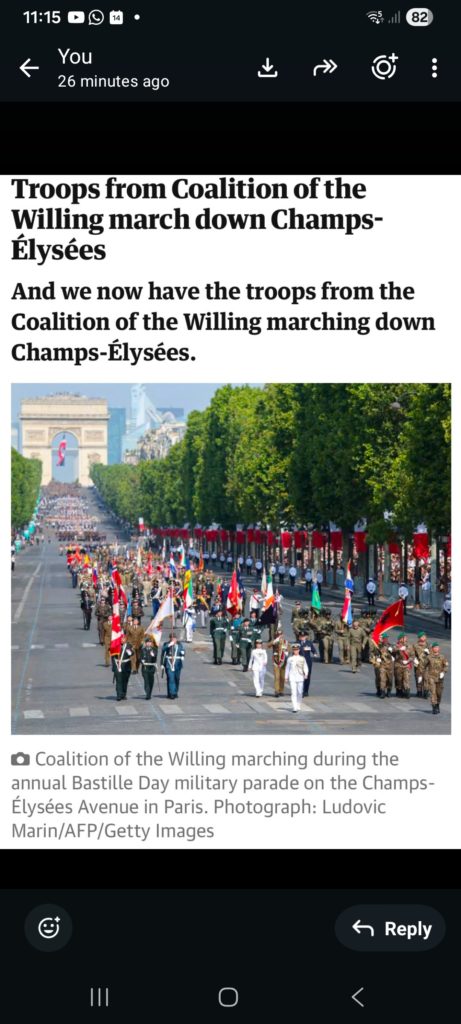
‘European troops and planes join Bastille Day parade in show of unity for Ukraine’
‘Some 500 soldiers from the “Coalition of the Willing” backing Ukraine marched down Paris’s Champs-Elysees on Tuesday in the annual Bastille Day parade, in a showcase of support for Kyiv and a symbolic flexing of European military muscle.’
*************************************************************************************JUNE 2026************************************************************************
*30-06-2026
Government is preparing Irish Defence Forces for the scrapping of the Triple Lock.
Neutral Ireland contributed Irish Defence Forces to the EU’s premier crisis management and rapid deployment live fire exercise in Spain, called MILEX 26.
This autonomous crisis management rehearsal acts as a validation test for the EU’s new Rapid Deployment Capacity.
A contingent of 10 Irish staff officers and NCOs worked at Eurocorps Force Headquarters in Strasbourg, operating directly alongside the Eurocorps planners. They provided the Command and Control architecture for EU Force Headquarters during MILEX 26.
Ireland’s contribution centered around the EU Battlegroups (EUBG) 2025/2026 force package.
Irish personnel served across key planning and coordination domains, including Intelligence, Operations, Training, Logistics, Strategic Communications, and as Political Advisors to the EUBG Commander.
Alongside the Eurocorps staff, Ireland contributed 182 soldiers (primarily from the Dublin-based 2nd Brigade) to the broader EUBG force, forming a Mechanised Force Protection Company and a National Support Element.
Source of info: People’s Movement. Link: https://www.people.ie/news/PN-286.pdf
*24-06-2026
Micheál Martin has been forced to delay plans to dismantle our Triple Lock, after coming under huge pressure. Let’s ensure that this becomes more than a temporary retreat!
’Martin tells Fianna Fáil meeting triple-lock Bill will be deferred until autumn.’
‘As Fianna Fáil TDs criticise scrapping of long-standing policy, Taoiseach says Bill will not be debated before summer recess.’
Harry McGee. The Irish Times. Wed Jun 24 2026
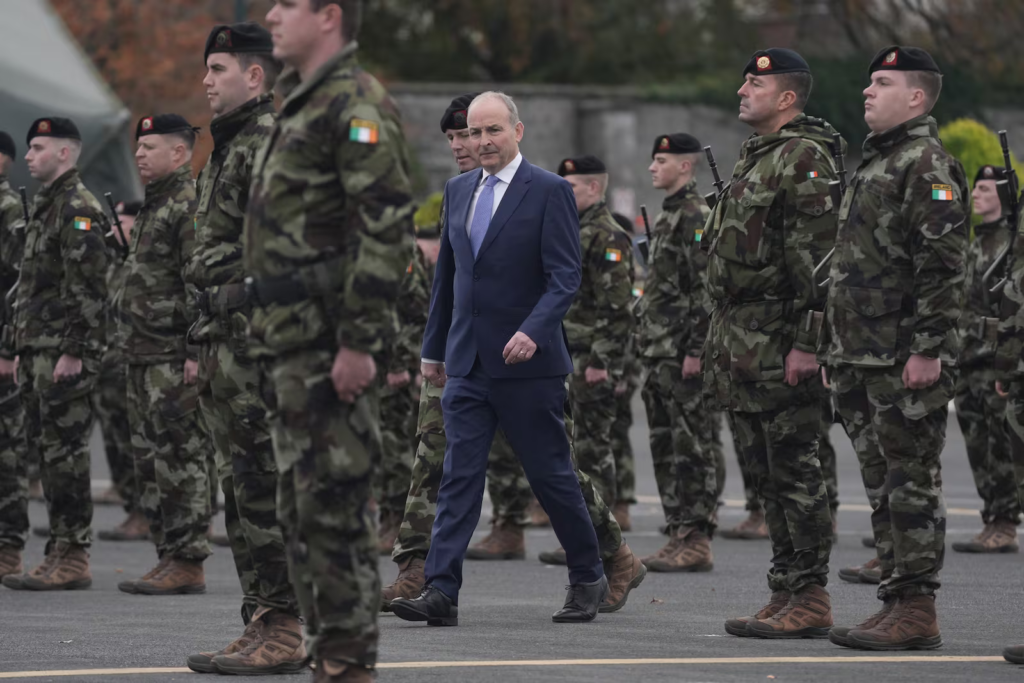
‘Micheál Martin reviewing the 125th Infantry Battalion at Custume Barracks, Athlone, Co Westmeath, in October 2024 before its six-month deployment with United Nations Interim Force in Lebanon. Photograph: Brian Lawless/PA Wire’
‘The Government will not proceed any further with legislation to remove the triple lLock until the autumn, Taoiseach Micheál Martin has told a meeting of the Fianna Fáil parliamentary party.
The Government approved the text of the Defence (Amendment) Bill 2026 earlier this month with the intention of having it enacted before the end of the year.
The legislation will provide for the removal of the triple-lock mechanism, which currently requires Government, Dáil and UN Security Council approval before members of the Defence Forces can be deployed overseas as part of international missions.
A number of Fianna Fáil TDs have expressed criticisms that the legislation was being rushed through without giving them a chance to discuss what would constitute a significant departure from the party’s established policy on defence and neutrally.’
*20-06-2026
The Fianna Fail/ Fine Gael government wanted to ram through legislation to remove the Triple Lock before the summer break. After coming under huge pressure from activists and the electorate, 20 Fianna Fáil TDs and Senators demanded the government paused its plans.
*16-06-2026
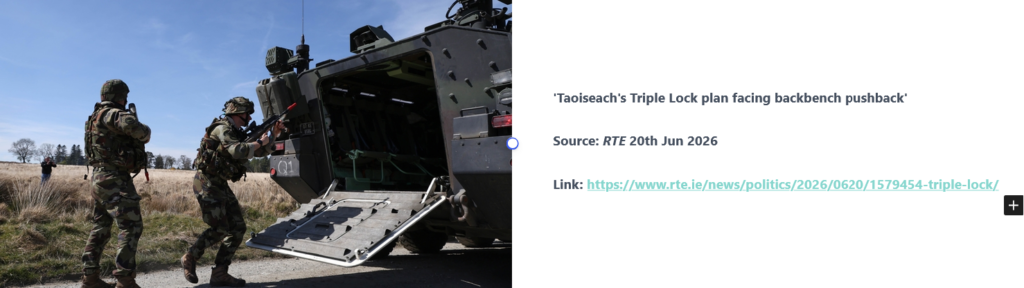
As the government moves to abolish the Triple Lock – voters and opposition parties say No!
The Government is set pressing ahead with plans to remove the triple lock governing overseas deployments of Irish troops in a move that would negate the State’s long-standing policy of neutrality. The Cabinet has approved the Defence (Amendment) Bill 2026 under which the approval of the UN Security Council would no longer be required for overseas deployment of Irish troops.
‘This move to abolish the Triple Lock mechanism represents a profound betrayal of the “solemn” commitments made to the Irish public during the Nice II (2002) and Lisbon II (2009) referendums. This mechanism was explicitly presented as an ironclad safeguard for Ireland’s neutrality. The 2002 Seville Declaration, endorsed by the EU, was a binding commitment that Ireland would maintain this condition for its participation in EU security initiatives. By dismantling it, the government is violating an explicit “social contract” with the Irish people.
Minister for Foreign Affairs Helen McEntee’s framing of this abolition as “taking back our sovereignty” is a deliberate distortion. She argues that the current system allows a UN Security Council veto—held by nations like Russia, China, and the US—to block new peacekeeping missions, stating, “We need to take back our ability to be able to deploy our troops.” However, the Triple Lock itself is a powerful exercise of Irish sovereignty, a condition secured to protect neutrality.
Replacing a concrete UN mandate with a vague requirement to act “in accordance with the UN Charter” does not reclaim sovereignty but surrenders it, potentially subjecting Irish troops to EU or NATO-led operations without proper international legitimacy.
The government’s refusal to hold a referendum on this fundamental change exposes an alarming democratic deficit. Despite overwhelming public support for neutrality and the Triple Lock—with polls consistently showing a desire to protect it—the government dismisses a referendum as “not necessary or appropriate.” By proceeding without a national vote, the government acknowledges it cannot win public support for this shift.
The government justifies the abolition by citing the need for flexibility, particularly for EU operations like the Rapid Deployment Corps, and points to the winding down of the UN mission in Lebanon (Unifil) as an example of the current system’s failure. However, this disregards Ireland’s distinguished 60-year history of UN peacekeeping, which earned international respect precisely because of its neutral stance and UN mandate. The government cannot cite a single instance where the Triple Lock prevented participation in a legitimate peacekeeping mission. Instead of building on this legacy, the new legislation chooses to abandon the UN cornerstone in favor of potentially controversial operations lacking UN authorisation.
The abolition of the Triple Lock is not merely a policy change but a fundamental betrayal of Ireland’s neutral identity and democratic principles. The proposed legislation, currently being brought forward may enhance reporting and introduce an independent monitoring mechanism, but these administrative changes cannot replace the lost legitimacy of a UN mandate. By proceeding without genuine public consultation, the government is ignoring overwhelming opinion and breaking explicit referendum promises.
This move draws Ireland deeper into EU militarisation, with Minister McEntee’s narrative of “taking back sovereignty” serving as a dangerous fiction that masks diminished national control. Without the Triple Lock, Ireland risks becoming a participant in foreign military adventures, risking the lives of our service men and women and potentially making the country a target for hostile forces, rather than remaining a respected force for peace and international law.’
Source: taken from The People’s News
*10-06-2026
Irish Times newspaper front-page advertisement demanding that the government keep us out of illegal wars by leaving the Triple Lock alone.
Wednesday 10th June 2026.
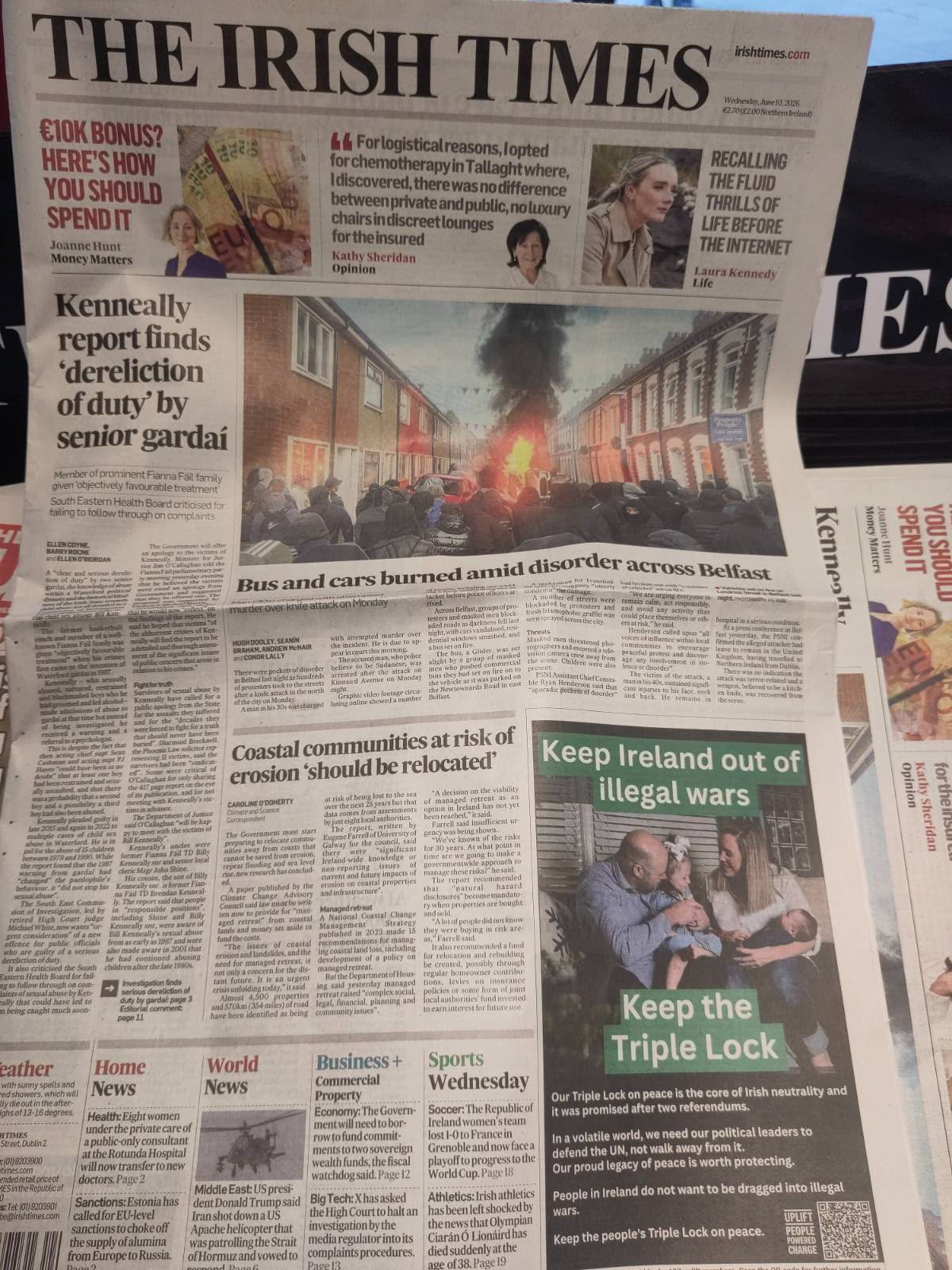 Ad by Uplift (https://www.uplift.ie/)
*09-06-2026
The Journal Poll 9/6/26 : Do you think Ireland should remove the Triple Lock?
Plans to remove the requirement of UN approval for overseas peacekeeping missions involving more than 12 Irish troops were put before cabinet on 9/6/2026. On the same day The Journal. ie ran a poll to ask:
‘Do you think Ireland should remove the Triple Lock?’
Poll Results *
No 5,280
Yes 3,289
Not sure/No opinion 579
The clear majority of those voting did not agree with removal of the Triple Lock.
The majority of Irish people have consistently shown in polls that we want to KEEP IRELAND NEUTRAL & KEEP THE TRIPLE LOCK!
* Source: https://www.thejournal.ie/triple-lock-ireland-cabinet-poll-7064762-Jun2026/
*09-06-2026
ICTU response to Government’s proposed removal of triple lock. Issued June 09, 2026
‘Commenting on the Cabinet approval for the Defence Amendment Bill, Irish Congress of Trade Unions General Secretary Owen Reidy said:
“Ireland’s strong record of service on UN peacekeeping missions is something of which the Irish public are rightly proud. The country’s commitment to multilateralism and the international rule of law is a core tenet of our foreign policy.
“The Government’s decision to move ahead with the Defence Amendment Bill, which would remove the triple lock, is therefore short-sighted, and would abandon these principles which have served Ireland well over the course of decades.
“The triple lock is an important backstop against the Government of the day deploying Defence Force personnel in instances that may not be supported by international law. While we accept that the current Government has no such intention, it should be aware of potential unforeseen consequences in future.
“While acknowledging the need for reform in the security council, removing the UN from this process weakens the guarantee that deployments carry formal legal sanction. At a moment when such institutions and processes are under attack, we should be proud to maintain our commitment to them.
“The Government’s blunt approach to abolition of the triple lock also does a disservice to a much-needed debate on Ireland’s approach to its defence in the current geopolitical climate. The trade union movement urges them to reconsider this approach, and engage substantively with the Irish public on these matters”.’
*Source: https://www.ictu.ie/news/ictu-response-governments-proposed-removal-triple-lock
*06-06-2026
‘Patrick Murphy: “Ireland is preparing to go to war – and we can’t do anything to stop it”.
If the Dublin government is preparing to abandon neutrality, who will be its enemy?’
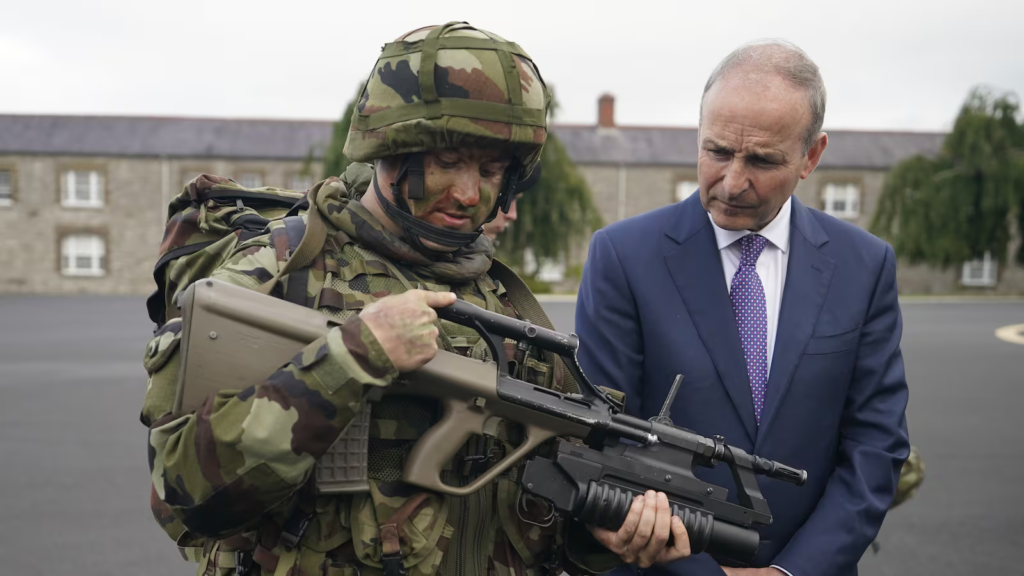
Micheál Martin is shown the weapon of a member of the Irish armed forces at Cathal Brugha Barracks, Dublin Picture: Niall Carson/PA
Opinion piece in The Irish News 6th June 2026
*05-06-2026
The World BEYOND War Europe Network has written the following open letter to two relevant Irish Ministries regarding their EU Council Presidency, which commenced July 2026.
Open Letter to Minister of State Thomas Byrne TD and Minister for Foreign Affairs Helen McEntee TD
By World BEYOND War Europe Network
Dear Minister Byrne, Minister McEntee,
World BEYOND War is a global nonviolent movement working to abolish the institution of war and build a just and sustainable peace. Our Ireland chapter, Ireland for a World BEYOND War, has been involved for years in ensuring a culture of peace is promoted in the country, and that Ireland is not made complicit in war crimes. At the European level, we have formed a network of chapters and affiliates called World BEYOND War Europe Network.
We are writing ahead of Ireland’s Presidency of the Council of the European Union starting in July 2026, and ahead of the publication of Ireland’s Presidency Policy Programme in June. We want to recognise the government’s effort towards inclusive preparation, including the public consultation that drew 484 submissions from civil society, and we write in that same spirit.
We believe Ireland’s presidency is a fundamental and timely opportunity. Article 29 of the Irish Constitution affirms the country’s dedication to peace and friendly settlement of international disputes. These are not just values that run deeply within Irish society, they are constitutional commitments that the government must uphold. Article 29 also lays the basis of Ireland’s neutrality and is representative of the history of Ireland as a country striving for de-colonisation and freedom of all people.
Ireland’s Council of the EU Presidency offers an opportunity to urgently address the current EU stand on “defense and security” policy. Through ReArm Europe, member states are pressured into meeting increasingly high military spending benchmarks, while they face similar issues to those you are confronted with in Ireland: record breaking numbers of homeless people, weakened healthcare systems, and greenhouse emission targets far from being reached.
Increased military spending will undoubtedly adversely impact these unacceptable situations. More fundamentally, increased militarisation across Europe contradicts Article 29 of the Irish Constitution, Ireland’s tradition of neutrality, and the EU’s own founding purpose as a peace project under Article 3 of the Treaty on European Union. Finally, reducing transparency and oversight of the overpowerful arms industry is also in direct conflict with Article 3.
We therefore urge the Irish Government to make use of its time during the Presidency to take the following steps:
- Resist mandatory military spending benchmarks as an increasingly normalised condition for EU member states, and resist any weakening of EU arms export control frameworks under the pretext of ‘simplification’ and ‘efficiency’.
- Recommit the European Union to full compliance with international law and to its own founding values as a peace project, while promoting a narrative of mutual regard and respect, trust and goodwill towards other international actors.
- Place peace, conflict prevention and mediation on the agenda of the European Political Community summit, which will be hosted in Ireland in November 2026.
- Take the opportunity of the Presidency to reinstate diplomacy as the first and rapid response of the EU to all conflicts now and in the future, by convening dedicated space within the Foreign Affairs Council for diplomatic resolutions of current conflicts.
- Use Ireland’s platform during the Presidency to actively promote the multitude of alternatives to military intervention, such as rapid civilian response mechanisms, unarmed civilian protection, training in civil resistance, and non-violent conflict resolution.
- Ensure that civil society members advocating for demilitarisation and peaceful conflict resolutions are meaningfully included in the Presidency programme, especially in the youth engagement programme.
- As mandatory military service re-enter public discourse across Europe, make use of Ireland’s platform during the Presidency to give visibility to conscientious objection as a right protected by the United Nations human rights system, recognised as an exercise of freedom of thought, conscience, and religion by Article 18 of the International Covenant on Civil and Political Rights.
- Use Ireland’s role in the Foreign Affairs Council to advocate for the rights of militarily neutral Member States to maintain their status.
We recognise the complex geopolitical moment in which we live, and we do not underestimate the constraint the Government faces, but we believe that these circumstances make your contribution and work more important than ever. Ireland’s unique historical and constitutional position gives it the authority and credibility to raise these questions at the EU and international level. Your work would not only serve the interests of Irish citizens but of all the citizens of Europe as they strive for peaceful coexistence.
Your sincerely,
World BEYOND War Europe Network
(Ireland for a World BEYOND War, Berlin for a World BEYOND War, International Peacefactory Wanfried, Romania for a World BEYOND War, Our House, Stop Fuelling War, Cessez d’alimenter la guerre, Another Development Foundation, Folk mot DCA, Ukrainian Pacifist Movement)
*05-06-2026
Disturbingly, Minister for Foreign Affairs Helen McEntee misleading the people of Ireland regarding the Triple Lock!
Yet another example of why we can not trust the government when it comes to decisions regarding engagement of Irish Defence Forces in genuine humanitarian/peacekeeping missions without the need of UN agreement. We need to keep the triple lock.
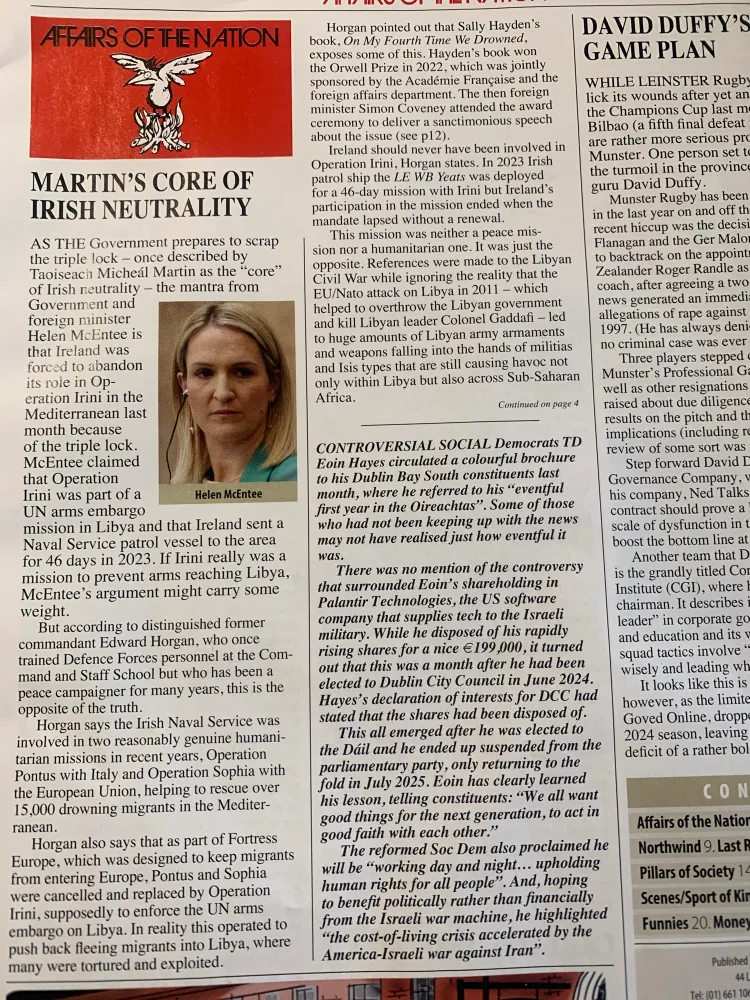
************************************************************************MAY 2026***********************************************************************************************
*20-05-2026
Neutrality and Anthropodicy
from The Irenaut, Spring 2024, 2024/1 Vol.2, pp 147-154. Updated May 2026
Mark Price
The following text appeared in the peace studies journal The Irenaut in 2024 (I have updated it accordingly). It addresses the critique sometimes made that Ireland is not and has never been neutral, and that therefore the campaign to protect Irish neutrality is futile or unfounded. The essay adopts the idea of ‘anthropodicy’ proposed by The Irenaut’s editors as an alternative to Leibniz’s ‘theodicy’ (the defence of God’s goodness in the face of evil and suffering).
Anthropodicy suggests that humans are ultimately good despite moral complexity, and my argument is that the historical cause of Irish neutrality is likewise positive despite compromises. I base this argument on the following distinction:
neutrality = realism imperialism = idealism
This is a reversal of the attitude of those that say neutrality is irrational or naive. European imperialism has always been founded upon a ‘civilising’ ideology, what today is passed off as humanitarian or human rights intervention, and the rhetoric from Brussels, Berlin, London and Paris in 2026 is squarely within this tradition. As I will show, Irish neutrality was born of a rejection of this ‘idealism’ going back to Wolfe Tone’s repudiation of England’s campaign against Spain in 1790, and reaching its apogee with James Connolly in 1914.
Introduction
- The Irenaut’s idea that peace can be ‘an expression of human agency inherent in work’, which strives to recover ‘the origin of work and its goal of human amelioration’, brings to mind the battered ideal of Ireland’s neutrality. Neutrality can be seen as force for good in its own right, not just a refusal to take sides. Yet what we see when we look closely is that this force itself is morally complex; that key neutrality activists in history have often been involved in violence and compromise, yet have shown a realism founded upon a repudiation of imperialist rhetoric, of the perennial calls to join this or that ‘coalition of the willing’. Perhaps the ‘irenic work’ lies in rejecting
these subtle but powerful lures. The history of Irish neutrality has its idealist players (Wolfe Tone and James Connolly, and today’s anti-war activists) and its ‘realpolitikers’ (Eamon de Valera and perhaps recent Irish Taoiseach Leo Varadkar); the presence of both – sometimes even in the same person, as in the case of Frank Aiken in the 1950’s – can be offered as evidence in support of anthropodicy, the human drive towards the good despite contradictory behaviours. What history shows is how popular liberation movements – the Russian and German revolutions of 1917 and ’18, or the Irish revolutions of 1798 and 1916 onwards – have been decisively anti-war in their
programmes and outcomes, even as they themselves involved compromising alliances and violence. Ordinary working people don’t want war, even if sometimes their leaders (who never send their own children to die on the front) succeed in whipping up jingoism to serve imperialist ends. Our irenic task is to identify the contemporary reincarnation of imperialist ideologies.
Ukraine 2022 and the First World War - Irish neutrality, battle-scarred, some would say on its last legs, has come under renewed attack since the Russian invasion of Ukraine in 2022. In response to the aggression by Vladimir Putin it seems merely bad form to sit on the fence. Everyone has been called on to take sides, and it seems which side you are on depends merely on whether you happen to live to the east or the west of the Donbas. Four years after the invasion, and two and a half years after Israel began its genocide of Gaza, the simple rights and wrongs of the situation have lost their moral sheen. When the world’s preeminent arms dealer is arming both the victim in one conflict and the perpetrator in the other (and indeed when the chief victim Zelensky has explicitly identified with the aggressor Israel while calling for more US weapons), we could be forgiven for getting confused about which side to take. What has become clearer is the need to articulate an alternative to taking sides.
- Irish history offers a lesson which goes back to a public meeting held in Dublin in October 1914. At that time there was also a story being promoted by the capitalist press that there was a victim (Catholic Belgium) and an aggressor (heathen Germany), and a huge mobilisation was underway to send young working class men to give their lives in the cause of justice. In Dublin the leading newspapers, The Irish Independent and The Irish Times, featured enthusiastic illustrated reports of rallies convened by the leader of the Irish Party at Westminster John Redmond, who called on volunteers to go to war in return for the promise by the British that after the war, Ireland would be granted Home Rule. In fact it’s now acknowledged that most recruits went to war to escape poverty; some 35,000 were killed, countless others had their young lives ruined. The above newspapers gave no coverage to a large counter-meeting which was held against the war, convened by Connolly and the newly-formed Irish Neutrality League. The slogan of this movement would later be displayed on the banner over Liberty Hall which said ‘We Serve Neither King nor Kaiser but Ireland’. Beyond the mere opportunism of ‘England’s difficult is Ireland’s opportunity’ lay a broader vision of anti-war activism.
- The similarities between autumn 1914 and spring 2022 are suggestive. Then and now it was the weaker power that began a new era of open conflict. Germany had entered late in the race between European powers to monopolise global resources. Redmond vigorously advocated participation in the war against Germany, just as today the leader of Fianna Fáil promotes Ireland’s integration with European militarism, in order to counter ‘the Russian threat’. Against this, Connolly was prepared to form ‘strange’ alliances against the war, and to put aside differences with other activists. The report of Connolly’s speech reads:
He had with him on the platform men drawn from all classes. There were labour men there, and men who by no stretch of the imagination could be called labour men. They had Home Rulers and Republicans, Socialists and Sinn Féiners (applause)…All of these represented ideals that were strangely different and ideas of the future that were strangely hostile…But having mentioned the things they disagreed on, he would now turn to the one thing upon which they all agreed, namely, that the interests of Ireland were more dear to them than the interests of the British Empire (loud applause). They wanted to emphasise the fact that the enemies of England were not necessarily the enemies of Ireland. - The political establishment in 1914 regarded anti-war activists as ‘either cowards or enemies’ (John Dillon). The rhetoric of warmongering was similar then to now: there were widespread reports of a rampaging invading force raping women and killing priests in Catholic Belgium during the early days of the war, and posters appeared on billboards. ‘Have you any women-folk worth defending? Remember the women of Belgium. Join today,’ one said; others appealed to ‘gallant Irishmen: It Will be Too Late to Fight When the Enemy is At Your Door, So Join Today’. Today the best-selling newspapers are fed rumours about Russian designs on our Atlantic seaboard, cyberspace and ‘undersea cables’, even as the only evidence that Russia posed a threat to the latter was the accusation – soon debunked – that Russia had sabotaged (its own) gas pipeline to Germany in the Baltic Sea in 2022. A piece in the Irish Times began with ‘Over the past two years Ukraine has been – literally – the first line of European defence against Russian predation’. However, the innocence of Belgium then has been transferred to Ukraine today with more
difficulty, which has increased as the ethnic complexities of the Donbas become more fully understood. Only elite commentators seem impervious to any acknowledgement of NATO and the West’s role in provoking Putin’s attack, and anyone who points this out is accused of ‘parroting Kremlin talking points’. Yet even as it’s clear that most people want a peace deal in Ukraine and an end to war, those ‘experts’ are lining up to tell us that now we need to join a European army and increase defence spending. - In fact the moral ambiguity which destroyed the certainty of the Allied cause took far longer to undermine the idea of World War I than it did to cast doubt on the ‘cause’ of the Ukraine War, which is showing signs of coming apart as an ideological project after just a few years. Connolly’s insight that the war in Europe was an inter-imperial conflict between elites – rather than a war between ‘nations’- is now commonplace among official historians; likewise the description of today’s Ukraine war as ‘proxy’ is now commonly used by non-mainstream analysts. The global rift of which the 1914 -18 war was the symptom had to do with shifts in the balance of power in Europe, whereas in 2022 the rebalancing is occurring not within Europe, but between ‘the West’ on one hand, and China and the Global South on the other. After forty years of globalisation, in which manufacturing industry has been outsourced from Europe and North America to cheaper labour markets, the world may be said to be divided between authoritarian producer regions, and liberal democratic consumer states, where weak economic growth has become dependent on financialisation (private debt, derivative trading etc.). Producers and consumers have come into conflict along the fault line of eastern Ukraine.
- In 1914 Connolly was responding to the official Irish policy of supporting the war effort by pointing out that Ireland’s interests were not those of the British Empire. In 2022 the Irish Neutrality League was reestablished in order to defend Irish neutrality against strenuous efforts by political elites to enlist Ireland on behalf of Ukraine against Russia. Lies were told and quickly exposed, such as the idea that Ireland would only offer ‘non-lethal’ assistance to the Ukrainians.
Yet believers in the righteousness of the anti-Russian or anti-German cause were not mere cynics. In fact neutrality advocates were the ones then as now who appear to be the sober realists. Wanting peace has usually meant wanting it now rather than after many more lives are lost, when some sort of peace deal will have to be worked our anyway. In this sense perhaps World Wars I and II, with their myths of total defeat of the Bad Guys, have served as encouragement to liberal imperialism with disastrous prolongations of subsequent wars. - This raises the difficult question, which nonetheless gets to the heart of neutrality as a positive force, of Irish neutrality and the Nazis. Surely no-one should be neutral in the face of Nazism? And yet this was exactly de Valera’s policy in 1939. In the report of the Consultative Forums organised by the Irish government in 2023 into changes in Ireland’s security and defence policy, much was made of the moral ambiguities of de Valera’s neutrality. Anti-neutrality advocates seem to place great store in the ideal of all-or-nothing. Because they make the common mistake of confusing neutrality with moralism, they think they’ve delivered the coup de grâce by pointing out its equivocations. A suspicion of moral duplicity has been cast over Irish mid-century policy. While sending ambulances and fire tenders to Belfast after German bombing in 1941 might be seen as a forgivable derogation from strict neutrality, allowing Allied planes to overfly Donegal during the war and sharing intelligence seems more like complicity. The post-war agreement with the British RAF to allow overflights and interceptions of ‘hostile aircraft’ in Irish airspace has been described as Ireland ‘freeloading’ on Britain for her security. But as recent Taoiseach Varadkar pointed out when questioned about this in 2024, if the British were to intercept enemy planes over Ireland, ‘…they would be doing it to protect themselves, not us’. Varadkar’s realism is not inconsistent with neutrality as a positive force for good in the world. In its earliest expression by Wolfe Tone, Irish neutrality is in the first instance a rejection of great power politics. When Britain was contemplating war with Spain in 1790, and expecting its Irish vassal to step up to the mark with military support, Tone wrote in his first pamphlet:
We should then look to our own internal resources, and scorn to sue for protection to any foreign state: we spurn the idea of moving as a humble satellite around any power, however great, and claim at once, and enforce, our rank among the primary nations of the earth.
‘The Spanish War’, Theobald Wolfe Tone (1790).
Anti-neutrality advocates today like to point out the alleged amorality of refusing to take sides, and the undoubted fact that Ireland is not a ‘primary nation’ which is in any position to ‘enforce’ anything. Our military is tiny by world standards and relatively ill-equipped. Their response to this is to suggest that Ireland should accept its ‘duty’ to contribute to its own security by joining military alliances, whether NATO-based or centred on the emerging European military industrial complex. - Neutrality however is not some reluctance or refusal to fight for justice or to accept responsibility for one’s own security, but a rejection of hegemonic dictates. It requires eagle-eyed discernment and a refusal to take sides in great power conflicts. Neutrality is not about failing to help a victim of an attack, but about spurning calls to extend the rescue into a ‘cause’. This is crucial to irenic work because it insists on the work of historical analysis, coupled with civil society activism to counter war propaganda. No attack is ever merely a bad act, but takes its part in some historical sequence or other. In this sense it is perfectly acceptable to help out Belfast victims of German bombing, and to want to save victims of Nazism, while refusing to take sides with either the Allies or the Axis powers. It is these ‘causes’ which produced both the horrors of Nazism and the excesses of Allied counterattacks (British and US bombing campaigns, including the inexcusable use of atomic bombs). Similarly one can condemn Putin’s invasion of Ukraine, but it behoves one to understand that this occurred partly as a result of thirty years of provocations by the West, including NATO expansion to the east and interference in Ukrainian democratic politics. This is necessary because whatever solution is available to the war in Ukraine, it must involve an agreement which addresses the security concerns of both sides. Irish neutrality is under attack today by people (all of them elite ideologues) who are adamant that the aggressor must be punished. Only from a position of neutrality, regardless of the fact that one side took the first step to war, can a peace deal be arrived at, as opposed to some putative retributive ‘justice’. What anti-neutrality imperialists in 1914 and today have in common is a moral crusade against ‘wrongdoing’ (confined of course to that attributed to imperial foes), rather than a programme for peace.
- The most interesting figure in the history of Ireland’s twentieth century neutrality, after Connolly, is Frank Aiken. During the 1950s and 60s he played an active role in the UN working towards conflict resolution (Irish UN membership had been delayed until 1955 because of a Soviet veto which was caused by Ireland’s wartime neutrality). Aiken was opposed in his policy of Cold War neutrality by Sean Lemass (later to be the Taoiseach who oversaw the first state’s first economic boom), who wanted Ireland to join the Anglo-American sphere of interest. However, it was arguably Ireland not taking sides in World War II which gave Aiken the opportunity to play a leading role in promoting nuclear non-proliferation treaties. Like Connolly, Aiken’s adherence to neutrality shouldn’t be confused with pacifism per se: both men were involved in violent revolutionary activity: Aiken was a prominent IRA commander during the Irish revolution, and may even have been responsible for a serious war crime during the Irish Civil War. Yet even as early as then, when he attempted to broker a pact between de Valera and Michael Collins which could have averted hostilities, he appears to have had an instinct for conflict resolution. His work at the UN in the 50s and 60s paved the way for Ireland’s distinguished role in UN peacekeeping, granting this small ex-colony a presence in international affairs far greater than its military or economic might, something which would not have been possible but for her neutrality. This is what ‘positive neutrality’ means.
- It’s this peacekeeping role which has become the target of today’s critics of Irish neutrality.
When the European Union decided to reform its structures in the 2001 Nice Treaty, including setting out plans for enhanced military cooperation, the Irish people rejected it in a referendum, partly because they feared it would compromise Irish neutrality. In order to get the treaty passed a second time, the Government got a military opt-out secured on behalf of the people. This included formal recognition of the so-called Triple Lock, whereby any plan to send more than 12 Irish soldiers on a peacekeeping mission abroad would require the consent of (a) the Dáil, (b) the Government and (c) the UN Security Council or General Assembly. Starting at least in 2013 the Government has been trying to roll back this assurance as follows:
This constraint may lead to an inability to act on occasions where there is a pressing moral or security imperative and overwhelming international support to do so, but where UN sanction is not forthcoming, in circumstances where a veto is exercised by a permanent member of the Security Council acting in its own national interests. (2013 Green Paper on Security and Defence).
Today’s Irish Neutrality League campaign in defence of the Triple Lock and against the US military use of Shannon airport. These activists have huge majorities of the population behind them (as recorded in successive polls), because the Irish population – including many recent immigrants – identifies with a history of colonisation more common in the Global South. Yet as the generation of leaders like Aiken who had fought for independence fades into the distant past, the danger posed
by today’s ‘Redmondite imperialists’ grows stronger.
Conclusion
12. Connolly and Tone were of course the most active sorts of activists, namely, revolutionaries. In their day they were almost universally vilified and demonised, yet today have public squares and main train stations named after them. Connolly’s politics were to be radically changed when he saw how the outbreak of war in 1914 led to the collapse of the Second International, as socialists all over Europe took sides with their respective capitalist rulers. In his remaining few years we see how he came to an accommodation with nationalism. The line for which he is best remembered, ‘The cause of Ireland is the cause of labour’, is cited to explain how he became aligned with the
Irish Republican Brotherhood, who didn’t hold to socialist principles. In truth it must be acknowledged that in this Connolly too was operating out of realpolitik: he had come to believe that national and socialist questions were synonymous in the case of Ireland. Lenin and Bukharin’s critique of imperialism can ground Connolly’s anti-war politics in Marxist theory if need be, but it would be a mistake to overlook his own experiences and difficulties with left factionalism at home and in America.
13. The idea I’ve been working towards is an anti-idealist neutrality. Even as we suspect that the Irish Taoiseach Micheál Martin is acting in the interest of his future career as an elite Eurocrat, it’s hard not to believe that he believes the lies he’s parlaying about Russian threats to Ireland (the same might’ve been true of Tony Blair in the lead-up to the invasion of Iraq in 2003; David Runciman described him at the time as a ‘sincere liar’). In like manner there’s no reason to believe John Redmond was intentionally misleading Irish people as he talked-up the pro-war cause in Kaiser Wilhelm then and Vladimir Putin today make for perfectly believable villains. What’s more challenging is to identify the precise confusions which class warriors like Plekhanov and Kautsky were suffering from when they called on their followers to press Pause on the revolution in order to deal with ‘the enemy’, not least because some of their views were demonstrably true: for instance, Germany was the aggressor, just as Russia is today. But Connolly and Lenin’s analysis calls for a more rigorous dissection of the concept of ‘nation’. Kautsky’s apparent acceptance of the right of German workers to defend their interests from their British and Russian counterparts must be rejected as false socialism. Some of the constituents of US left-leaning politicians Bernie Sanders and John Fetterman are no doubt securely employed making rockets and missiles, the sale of which the American government facilitates to states like Israel and Saudi Arabia, engaged in more or less genocidal attacks against Palestinian and Yemenese innocents.
This could plausibly explain the hesitation (Sanders) or refusal (Fetterman) to call a halt to weapons sales to Israel. This is where we must look to analyse the use and abuse of nationalism. We can argue that anti-imperialist nationalism is always the ‘cause of labour’, but any other nationalism is probably being invoked (more or less cynically) to garner popular support for ruling-class programmes. The crucial weakness of European elites today resides in their attempt to put together an imperialist army without the heady intoxicant of nationalist rhetoric. The fear mongering around Putin can only go so far. Eventually everyone must become neutral, and sit down to the messy business of making peace.
Mark Price works as an architect in Dublin and was formerly a lecturer in University College Dublin and Queens University Belfast. He is a member of the Irish Anti-War Movement and Irish Neutrality League.
*15-05-2026
‘Triple Lock our Future’ action outside the Fianna Fáil Ard Fheis. (Uplift)
*03-05-2026
‘Ireland must retain triple lock to protect peacekeeping role, says former PDForra chief’
by Sean O’Riordan. Irish Examiner 3rd May 2026
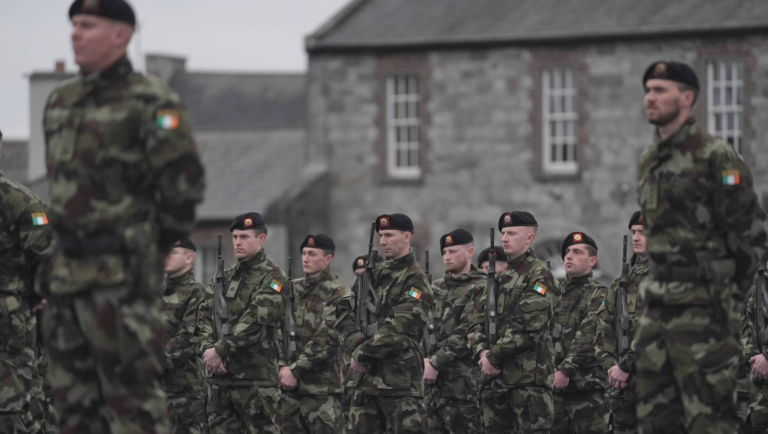
‘Men and women of the 125th Infantry Battalion at Custume Barracks, Athlone, Co Westmeath, ahead of their six-month deployment to South Lebanon as part of United Nations Interim Force in Lebanon (Unifil) in October 2024. Picture: Brian Lawless/PA Wire’
Link to article: https://www.irishexaminer.com/news/arid-41837093.html
**********************************************************************APRIL 2026************************************************************************************************
*24-04-26
‘US Troops At Shannon Airport Jumped 80% Ahead Of Iran Attack’
by Louise Ducrocq. Radio Nova FM. 24/04/2026
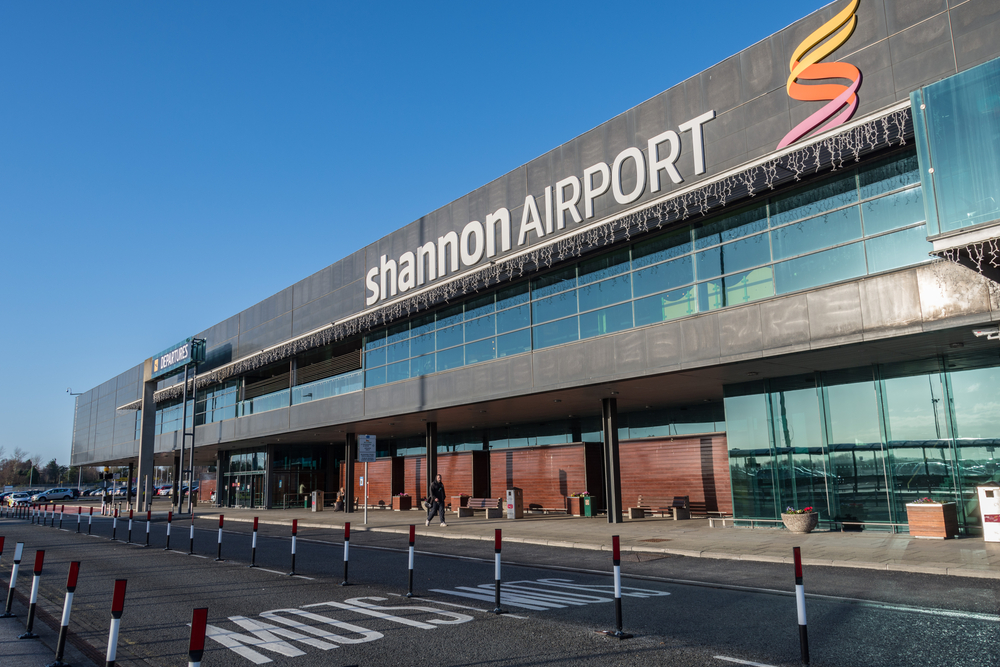
‘The number of US troops passing through Shannon Airport surged by 80 per cent in the early months of the year, coinciding with the outbreak of conflict involving Iran, according to newly reported figures.
Data shows that 2,012 troops travelled through the airport in January, rising by nearly 600 in February. However, the most significant jump came in March—immediately after the conflict began—when 3,604 troops were recorded transiting through the Midwest hub.
The figures, first reported by The Irish Times, have reignited debate around Ireland’s neutrality and the long-standing use of Shannon as a stopover point for US military operations. While the Government has consistently denied facilitating US military strikes by allowing aircraft to pass through Irish airspace, the scale and timing of the increase has drawn renewed scrutiny from campaigners and political figures.
The latest data adds to an already complex picture surrounding Ireland’s role in global military logistics. Over the past two decades, millions of US troops have passed through Shannon Airport, which has developed into a key transit point—particularly during conflicts in the Middle East, including wars in Iraq and Afghanistan.
More recent figures analysed by RTÉ News show that between 2022 and 2024, nearly 2,000 US military aircraft and US civil operators carrying declared munitions of war applied for permission to land in or fly over Ireland. These flights frequently travelled between key military hubs such as Germany, Poland, Bulgaria, and Kuwait.
Despite the scale of activity, inspections remain rare. Only 0.1 per cent of applications from US civil aircraft were refused due to the nature of the munitions being carried, while no US military aircraft was prevented from landing in Ireland during that period.
Under Ireland’s Air Navigation Order 1952, foreign military aircraft require permission to land or overfly the State. However, a long-standing arrangement dating back to 1959 allows US military aircraft to pass through Irish airspace without prior notification, provided they are unarmed, carry no munitions, and are not engaged in active military operations.
Aircraft carrying weapons or military equipment must apply for special exemptions, although these are routinely granted. Many of these flights are classified as “technical stops”, involving refuelling and maintenance rather than operational deployment.
The Government maintains that Ireland is militarily neutral, meaning it does not participate in military alliances or combat operations, while still permitting overflights and landings under strict conditions. However, critics argue that the volume and nature of US military traffic through Shannon raises legitimate questions about the boundaries of that neutrality. Advocacy groups have long called for stricter inspections and greater transparency, particularly amid concerns over the transport of weapons or involvement in controversial conflicts.
Separate reports have also added to the controversy. In February, The Guardian claimed that a private jet chartered by US authorities stopped at Shannon twice while deporting Palestinians to Israel. The Department of Transport stated at the time that no permits were required as no passengers disembarked.
Shannon Airport’s strategic location on the western edge of Europe has made it a key refuelling point since it opened in 1945. Its relatively low congestion compared to major hubs such as London or Amsterdam, combined with extensive runway and ramp space, has made it particularly attractive for military and diplomatic transit. Historically, the airport has hosted a wide range of global figures—from John F. Kennedy in 1963 to George W. Bush during the Iraq War—highlighting its long-standing geopolitical significance.
Despite ongoing debate, the Government continues to insist that the use of Shannon by US forces does not breach Ireland’s policy of neutrality, stressing that no military operations are launched from Irish soil and that all activity is subject to international law and domestic regulations. Nonetheless, the sharp rise in troop numbers following the outbreak of conflict with Iran is likely to intensify scrutiny in the months ahead, as questions persist over Ireland’s role in the global military supply chain.’ Link to article: https://www.nova.ie/us-troops-at-shannon-airport-jumped-80-ahead-of-iran-attack/
*14-04-2026
Members of the Oireachtas invited to meet Lelia Doolan as she arrives at Dáil.
Peace group ‘Lex Innocentium 21st Century’ has contacted the individual members of the Houses of the Oireachtas to ask all TDs and Senators to meet with Lelia Doolan as she completes her Walk for Peace to the Dáil on Wednesday 15th April at noon. Lex Innocentium wrote:

Dear [TD/Senator],
Lex Innocentium 21st Century were delighted to join Ms. Lelia Doolan on her walk from Shannon Airport to Dáil Éireann over the past fifteen days. Lelia’s message is that the use of Shannon Airport by US Military (or any other Military currently engaged in war or war-related activity) makes Ireland, a neutral country, complicit in that war – including the deaths of thousands of innocent people and damage to the natural environment. War is never the solution!.
Lelia and her fellow walkers plan to arrive at Dáil Éireann tomorrow morning, Wednesday, the 15th of April. If this inspirational 91-year old woman can walk the entire width of Ireland to hand in her message to the Oireachtas, the least you can do is to come out and meet her.
Lelia is not on a tractor or in a truck. She is on foot. This is a march of peace for peace. You should legitimise this peaceful method of protest by meeting it in person.
Yours faithfully, Marian Naughton, Seán English and Elizabeth Cullen
on behalf of Lex Innocentium 21st Century
———————————————————————————————————————————————————————————————-
*12-04-2026:
WILLIE O’DEA TD: Parties must end the doublespeak around triple lock or Defence Forces could become a political pawn. source: Irish Independent. 12th April 2026.
***********************************************************************MARCH 2026************************************************************************************************
*7-03-2026:
Full text of speech by Mr. Eamon O’Cuív, former Minister/TD on ‘The Future of Irish Neutrality‘ delivered at Léacht Lex Innocentium 21st Century Wynns Hotel
The Future of Irish Neutrality
The Constitutional basis for Ireland’s approach to defence and foreign affairs is set out in several articles in the Irish Constitution. These are-:
Article 5
Ireland is a sovereign, independent, democratic state
Article 29 1
Ireland affirms its devotion to the ideal of peace and friendly co-operation amongst nations founded on international justice and morality
Article 29 2
Ireland Affirms its adherence to the principal of the pacific settlement of international disputes by international arbitration or judicial determination
Article 29 3
Ireland Accepts the generally recognised principles of international law as its rule of conduct in its relations with other states
Article 29 4 4
Ireland Affirms its commitment to the European Union within which the member state of that Union works together to promote peace, shared values and the well-being of their peoples.
Article 29 4 9
The State shall not adopt a decision taken by the European Council to establish a common defence pursuant to Article 42 of the Treaty on the European Union where that common defence would include the state.
Article 42 of the Treaty on the European Union (TEU) establishes the framework for the EU’s Common Security and Defence Policy (CSDP). Key to this is Article 42(7), the mutual assistance clause, which mandates that if an EU Member State is the victim of armed aggression on its territory, other member states must provide aid and assistance by all means in their power.
Part of the context of this is that it is part of the broader Common Security and Defence Policy, which aims to provide the EU with operational capabilities for peacekeeping, conflict prevention and strengthening international security.
Invocation Article 42(7) has been invoked once by France in November 2015 following the Paris terrorist attacks.
I believe it is imperative in order for Ireland to adhere to its constitutional obligations that it pursues an independent foreign and military policy at the UN and at meetings of the EU. This is possible and we see many of the larger EU countries acting unilaterally on foreign and defence policy when the case suits them
Already it is constitutionally forbidden for Ireland to join a mandatory EU defence pact, and my view is that it is against the spirit of the Constitution, if not the letter of the law, to become a part of any common defence arrangements voluntarily on a case-by-case basis. An example of this is the so called “Coalition of the Willing”.
So, the question arises! What policies we should adopt and how can we be pro-active on the international stage in line with our Constitution?
Defence of our island
The first obligation of a state is to make its territory as safe as possible for its citizens to live in.
One of the most important protections we have, whether it is personal or a country, is to create a situation that nobody if out to harm or kill you. Unknowingly we all apply this principal in our everyday lives as we largely avoid situations of potential danger, and we try to create a society that is relatively safe.
Ireland is a relatively safe country to live in day to day with a largely unarmed police force and a public few of whom carry personal protection weapons or spend significant money on day-to-day personal security. In other societies despite high expenditures on personal security, and many people carrying personal protection weapons there is a much higher risk to life
Similarly to personal security, the first basis of security for a country is to not threaten any other country and not be seen to be aligned militarily with countries with overseas interests that appear to pose a threat. In other words, to avoid situations that by association you get drawn into wider worldwide conflagrations. We have seen an example of this in the recent US/Israel v Iran war which the UK got drawn into when their base in Cyprus was attacked and where now the Secretary General of NATO Mark Rutte is sabre rattling on behalf of NATO against Iran as part of a domino effect.
In the Irish case we are better off trying to ensure we stay apart from alliances that have as members countries such as the USA, France and UK which have overseas bases in many parts of the globe protecting their interests. Many of these bases in the case of France and the UK are remnants of their imperial past.
In our case our first object should be to not get drawn by association into a conflict. Secondly, we should through our embassy network and through foreign embassies accredited to Ireland stress our policy of military neutrality and our constitutional values of the adherence to international law and the pacific resolution of international disputes. Irrespective of our differences with various countries we should keep strong diplomatic ties with them all and in a polite but forceful way diplomatically outline our views and values to them and impress on them -:
1. That there is no reason to attack us or our infrastructure as we will do them no harm and
2. That in the event of attack we will stand our ground in the most appropriate way open to us at the time.
There should be a reasonable and detailed assessment of the risks to our sovereignty and appropriate action to strengthen our resilience including reasonable and focused investment in our defence forces.
One of our biggest challenges is the retention of trained staff in the defence forces due to inadequate remuneration. This should be addressed forthwith.
We also need to strengthen drug interdiction as drugs cause so much havoc and loss in our country.
In relation to maritime infrastructure there should be clarity in relation to our responsibilities and single sovereign power to protect and enforce our rights not only in our territorial waters (12 miles offshore) but also in our economic zone.
We have many assets in our waters including fishing rights, gas pipelines, electricity connectors, telecommunications cables, harbours and ports as well as shipping.
Unfortunately, most of our fishing rights are already given away through our membership of the EU and botched fishing negotiations stretching back to 1973.
The question in relation to telecommunications cables is first to establish our responsibilities and then consider how best to protect them and whether cyber-attacks are a more likely method of disruption than physical attack on the cables.
In the air I totally support the acquiring of primary radar and any other method of collecting information on the misuse of our air space by “bad actors”. Once accurate data is available then it will be possible to really assess how best to minimise the risk to us form this source and how best we might defend ourselves.
On land the greatest threat from outside the state is not that we would be faced with outright war but that there would be terrorist attacks by people from societies who would have seen their countries destroyed by war, financed and armed from the major world powers. Again, aside from normal intelligence work our greatest protection is if Ireland is seen as a haven of world justice and a supporter of international law.
Another source of concern for me is the fact that part of our Island is controlled militarily by the UK which is much more likely to be a magnet for attack than Ireland. At the very least the Irish Government should insist on a protocol agreeing that any change in the present defence arrangements in terms of bases in NI would not take place without the agreement of the Irish Government.
As the 9/11attacks, the assassination of US presidents, the drones that closed Brussels airport and the blowing up of the Nord Stream pipeline showed there is no absolute defence against all types of attack even for the countries that spend the most on defence. So let us not delude ourselves that any of the alternatives to our policy of a hierarchy of peaceful settlement of international disputes, neutrality as outlined, diplomacy and reasonable defence will make us more immune to attack. The opposite is really the truth.
Ireland’s role on the world stage
Ireland over the decades has a proud record in both the League of Nations and the United Nations in supporting International Law and promoting peace through for example the lead we gave on nuclear non-proliferation and peace keeping.
In relation to the UN Ireland should become more vocal than ever on the central role of the UN in world affairs. We should seek support for changes to its outdated structures that dates back over 80 year and seek to make it more powerful and democratic.
There is a need for the UN to have a mechanism to give an independent view as to whether the actions of a nation in war were legal or not.
Furthermore, at UN level there is a need to once again tackle the issue of the proliferation of nuclear arms, and here again we should give a lead.
If the world is to reduce war and avoid destroying our world and impoverishing people, the UN must tackle the arms race and seek to reduce the arms produced in the developed world many of which are used in the poorest of countries. If the money spent on arms in the Third World was spent on development aid the world would be a better place.
In relation to the EU, Ireland must oppose recent moves to deregulate how arms are produced and sold creating a dangerous precedent for global security.
Ireland should also oppose all EU budgetary aid to the arms industry and oppose promoting arms production and sales as an EU international sales growth area. We should also go further and make it clear that we will not fund arms production from our large contribution to the EU budget.
I have noted, recently, that 5 EU countries – Latvia, Lithuania, Finland, Poland and Estonia have announced their intention to withdraw from the Ottawa Convention against the production and placing of land mines. Land mines mainly kill and maim civilians and were banned for that reason. Again, we should be vocal in the UN and the EU in our opposition to this.
Ireland should not get involved in international military missions not related to humanitarian relief, natural disaster or rescue unless there is a UN mandate going with it.
I note that the recently published heads of the 2025 Defence Bill in head six states that Ireland will only participate in an International Force if that acts in accordance with the “the principles of the United Nations Charter” or “the principles of justice and international law”. As we have seen in recent weeks some countries acting unilaterally claim they are acting according to these principles when they clearly are not. Unfortunately, they were not held back by any requirement to validate their claim pending UN endorsement. We are now attempting to go down the same road as part of our voluntary abandonment of neutrality in favour of a voluntary “Common Defence” in Europe.
Therefore, what we need is a process of validation of all our foreign military actions by the competent authority, which is the UN. This is exactly what we have at present. Therefore, the Triple Lock should remain as the third leg on the stool and the independent validation of our foreign military actions. Instead of further weakening the UN we should be reforming it and strengthening it.
There are those who will say I am an idealistic dreamer and not living in the real world.
In response I will quote the works of PH Pearse
“Since the wise men have not spoken,
I speak that am only a fool;
A fool that has loved his folly
Yea, more than the wise men their books or their counting houses
or their quiet homes,
……….
O wise men, riddle me this:
What if the dream comes true?
What if the dream comes true?
And if millions unborn shall dwell in the house that I shaped in my heart,
The noble house of my thought
source: Éamon Ó Cuív.
pics: Oireachtas.ie / facebook.com
———————————————————————————————————————————————————————————————–
*14-03-2026
The government opens the gate to NATO – under British leadership.
The government is seeking closer maritime co-operation with Britain and other NATO countries. The first National Maritime Security Strategy [1] outlines plans that defence minister McEntee said could entail seeking naval assistance from Britain and France during Ireland’s EU presidency that starts on July 1.
The strategy said Ireland would in the second quarter of this year “commence an agreement” with the NATO countries in the Joint Expeditionary Force (JEF) [2] “to participate in appropriate activities”. McEntee said the scope would involve “looking at training, looking at how we can identify and manage specific and certain types of risks in our maritime domain . . . we are looking at ways in which we can co-operate more in these types of partnerships”.
The JEF was initially a British-only formation, conceived at a time when British forces were overstretched in Afghanistan and Iraq. The concept was first set out [3] in 2012 as a force “capable of projecting power with global effect and influence.”
And as a rapid response force distinct from NATO. It also includes NATO members Denmark, Estonia, Finland, Iceland, Latvia, Lithuania, Netherlands, Norway and Sweden. Its activities are focused around the North Atlantic. For the moment, the government does not envisage joining the JEF itself, but rather participating in activities of the so-called JEF+, an enhanced partnership structure which enables ad hoc co-operation and is widely perceived as a gateway to NATO.
The JEF was an example of how NATO allies implemented the Framework Nations Concept [4] where groups of allies would work together under the leadership of a framework nation to develop rapidly deployable capabilities. In the case of the JEF, Britain provides the headquarters—known as the Standing Join Force Headquarters [5] —and the commander, plus the lead commando, airborne, armoured, aviation, air, and maritime task groups.
The national units involved are planned to be deployable in a range of combinations and capable of responding to a variety of contingencies. Once at least two member states agree to do something, JEF arrangements can be triggered; other countries can then decide whether to take part. For the units involved in the JEF, the group has become a vehicle to increase interoperability through an intensive program of exercises. The JEF also provides a framework for regular discussions of military issues among defense ministers, chiefs of defense staff, and heads of government.
The tight geographic focus of the group has allowed them to forge a closer network of relationships than would have been possible just under a pan-NATO umbrella. The ultimate vindication of this was the quick and smooth integration of former neutrals Sweden and Finland – who joined JEF in 2017 – into NATO after 2022. This was largely built on the work they had done with the other JEF members to develop common principles of operation and understanding in both the military and political spheres, a road that Ireland has already significantly progressed along.
Concurrently, the government is updating a memorandum of understanding with Britain ahead of a bilateral summit this month, which will focus on maritime security. It has also begun negotiations with France on enhanced co-operation and information sharing. The government is also purchasing sonar and radar, due for delivery next year though anti-drone capabilities are expected to be in place for the EU presidency. Ireland will also host a summit of the 47-member European Political Community, including Ukraine, during the period of its EU Presidency.
None of these moves have been approved by the electorate. On the contrary, popular support for neutrality stood at seventy percent in a recent Sindo poll. Even by the standards of Micheál Martin’s recent definition of ‘military neutrality’ in reply to Mairead Farrell TD, this can only be considered a betrayal of the trust of the electorate, especially when taken in the context of the planned abandonment of the Triple Lock.
- https://www.gov.ie/en/department-of-defence/publications/national-maritime-security-strategy-20262030/
- https://jefnations.org/
- https://www.gov.uk/government/speeches/chief-of-the-defence-staff-general-sir-david-richards-speech-to-the-royal-united-services-institute-rusi-17-december-2012
- https://www.nato.int/en/about-us/official-texts-and-resources/official-texts/2014/09/05/wales-summit-declaration
- https://en.wikipedia.org/wiki/Standing_Joint_Force_Headquarters
source:
image:
————————————————————————————————————————————————————————————————